
The Mission and Collaboration
 Robotic experiments were being performed attempting to use the API and mathematical algorithms to allow a quantification of surgical skill.
Today the Surgical Research Laboratory serves as a core facility to centralize research projects and facilitate collaboration between surgeons representing their respective divisions. Our group consists of members specializing in Aneurysm Biology, Bariatric Surgery, Cardiac Surgery, Minimally Invasive Surgery, Robotic Surgery, and Vascular and Endograft Surgery. We also collaborate with many other SLRHC hospital departments including the Departments of Pathology, Pulmonology, and Cardiology. Projects also include alliances with researchers at the Columbia College of Physicians and Surgeons. The Research laboratory is conveniently located across the street from the Columbia University Undergraduate Campus.
Clinical and Basic Science Collaboration
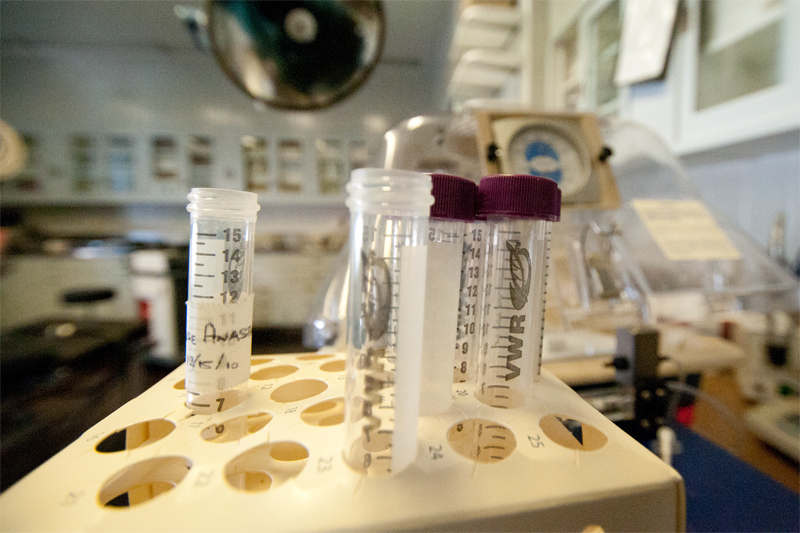 A portable animal intensive care unit is seen in the background of test tubes marked with inflammatory markers for tumor research.The capabilities of the surgical team for clinical research are augmented by the proximity of the St. Luke's space to medical researchers as well as the Columbia facilities across the street.
Research Fellows
 A laparoscopic suturing module is demonstrated. This simulation system allows residents to practice on a safe training system prior to attempting any procedures in the operating room.
Two surgical residents are chosen each year after completing their PGY-3 training to perform a research fellowship. One or both residents will stay on at the labs at St Luke's-Roosevelt to continue both clinical and basic science projects. In addition to the many staff attendings and fellows who facilitate projects in their respective fields, there is also one full-time employee and often at least one pre-medical student who complete the group. Our facilities are located at St. Luke's Hospital in the S&R building on the 11th floor and include a chemistry lab, cell-culture room, two inanimate training labs, an operating room that accommodates large animal experiments, as well as office space and an adjoining conference room with teleconferencing and video-recording capabilities.
Operating and Endoscopic Capabilities
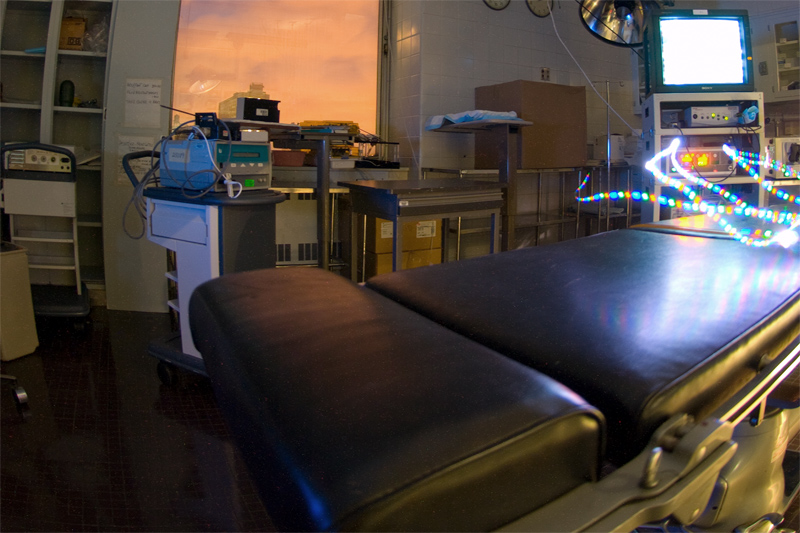 The operating facilities on the surgical research floor have full laparoscopic and endoscopic capabilities. A wide variety of experiments have evaluated everything from Natural Orifice Endoscopic Surgery to different operative approaches for hernia repair. Training modules are available for resident teaching.